Muscle Protein Synthesis Regulation During Energy Restriction
Understanding anabolic signalling pathways and protein turnover dynamics in hypocaloric states.
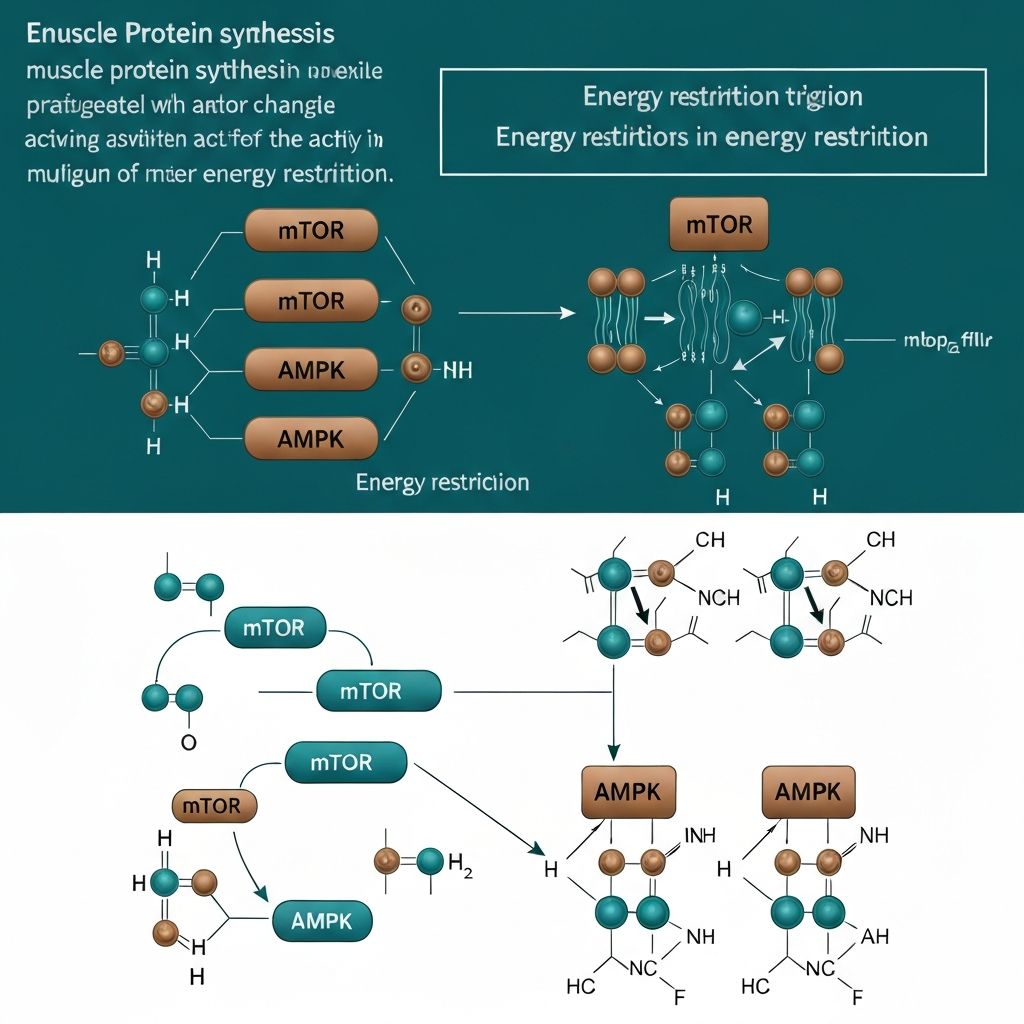
Introduction to Anabolic Signalling
Muscle tissue exists in a dynamic equilibrium between anabolic and catabolic processes. Muscle protein synthesis (MPS) represents the construction of new muscle proteins, whilst muscle protein breakdown (MPB) represents their degradation. The net direction of this balance—whether toward growth, maintenance, or loss—determines long-term changes in muscle mass.
The primary physiological signal driving MPS is mechanical loading coupled with amino acid availability. When resistance training generates tension on muscle tissue, mechanoreceptors activate intracellular signalling cascades. Simultaneously, circulating amino acids activate nutrient-sensing pathways. These signals converge on the mTOR pathway, the central regulator of translation initiation and ribosomal biogenesis.
The mTOR Pathway and Energy Status
The mechanistic target of rapamycin (mTOR) is a serine/threonine kinase that integrates multiple input signals—mechanical stress, amino acid status, energy status, and growth factor signalling—to regulate protein synthesis rate. Under fed, energy-replete conditions with adequate amino acid availability and mechanical stimulus, mTOR phosphorylates and activates downstream effectors including S6K1 and 4E-BP1.
S6K1 activation enhances translation efficiency by phosphorylating the ribosomal protein S6. 4E-BP1 phosphorylation releases the translation initiation factor eIF4E, permitting it to bind eIF4G and form the eIF4F complex, which is essential for mRNA scanning and ribosome recruitment to the 5' cap structure. These coordinated phosphorylations increase the rate at which ribosomes initiate translation of muscle proteins.
mTOR Suppression in Energy Deficit
When systemic energy becomes restricted, several signals suppress mTOR activity. Reduced ATP/AMP ratio activates AMPK (AMP-activated protein kinase), which directly phosphorylates the mTOR regulatory protein TSC2. This phosphorylation enhances TSC2's ability to inactivate mTOR's upstream activator Rheb, thereby suppressing mTOR signalling.
Additionally, energy deficit often reduces plasma insulin levels. Insulin signalling normally activates PI3K/Akt pathways that phosphorylate TSC2, inactivating it and allowing Rheb-mediated mTOR activation. Reduced insulin removes this activation, creating a second mechanism of mTOR suppression.
The combined effect is a downregulation of basal mTOR activity and baseline MPS rates during energy restriction. This adaptive response redirects limited cellular resources away from protein synthesis—an energetically expensive process—toward catabolic pathways that mobilise substrates for systemic energy needs.
Acute Mechanical Override of Energy Constraints
Despite the overall suppression of mTOR during energy deficit, acute resistance training generates mechanical signals that directly activate mTOR through mechanisms largely independent of energy status. These mechanisms include calcium-mediated signalling, RhoA-mDia2 activation of transcriptional pathways, and direct mechanosensitive signalling through mTOR complexes.
Calcium influx during muscle contraction activates calmodulin-dependent protein kinases and calcineurin, both of which activate downstream mTOR-signalling effectors. The mechanical deformation of the sarcoplasmic reticulum and other cellular structures appears to generate direct mTOR activation signals. Importantly, these mechanical signals generate a temporary window—typically 24–48 hours post-exercise—during which MPS rates are elevated above basal levels even in the energy-restricted state.
Protein Turnover Balance and Net Protein Retention
The preservation of muscle mass during energy deficit with resistance training depends on achieving a favourable net protein balance, defined as:
Net Protein Balance = Muscle Protein Synthesis – Muscle Protein Breakdown
During energy deficit without training, both MPS and MPB typically shift downward, but MPB may decline less proportionally, creating a negative net balance (loss of mass). The addition of resistance training acutely elevates MPS above the suppressed basal level, potentially creating a short-term positive balance. Repeated training sessions accumulate these positive windows, attenuating net lean mass loss over time.
The magnitude of this protective effect depends on training volume and intensity (which determine the mechanical stimulus to MPS), protein intake (which determines amino acid availability for synthesis), and deficit magnitude (which determines the degree of systemic mTOR suppression).
Amino Acid Sensing and mTORC1 Activation
Amino acid availability represents a second major input regulating mTORC1 activity. The leucine-sensing pathway, mediated by sestrin and GATOR2 complexes, detects cytoplasmic leucine levels and signals to mTOR. When leucine or other branched-chain amino acids are abundant, these pathways activate mTOR independent of energy status.
This principle explains the significant role of protein intake during energy deficit. Adequate protein consumption (especially protein rich in leucine and other branched-chain amino acids) can partially restore mTOR activity even when systemic energy is limited. This restoration further enhances post-exercise MPS rates in the hours following resistance training.
Longitudinal Implications
Over weeks of consistent resistance training during energy deficit, the cumulative effect of repeated acute MPS elevations can stabilise or even modestly increase lean mass in some populations, particularly those with lower baseline training status. However, the sustained suppression of mTOR and systemic energy limitation means that the protective effect eventually plateaus. Very severe or prolonged deficits (greater than 45% below maintenance for extended periods) eventually overwhelm the training stimulus, leading to progressive lean mass loss.
Understanding this mechanism illustrates why resistance training is more protective against lean mass loss during moderate deficits (15–20% below maintenance) than during severe deficits, and why training consistency combined with adequate protein intake represents the most effective strategy for minimising protein loss in energy-restricted states.
Important Limitations and Context
This article presents educational information on physiological mechanisms. Content is informational only and does not constitute personal exercise or nutritional recommendations. Individual responses vary based on genetics, training history, and other factors. For decisions regarding personal practices, consult qualified professionals.