AMPK-mTOR Crosstalk in Restricted Energy Availability
Understanding metabolic sensing pathways and how training signals override energy-dependent suppression.
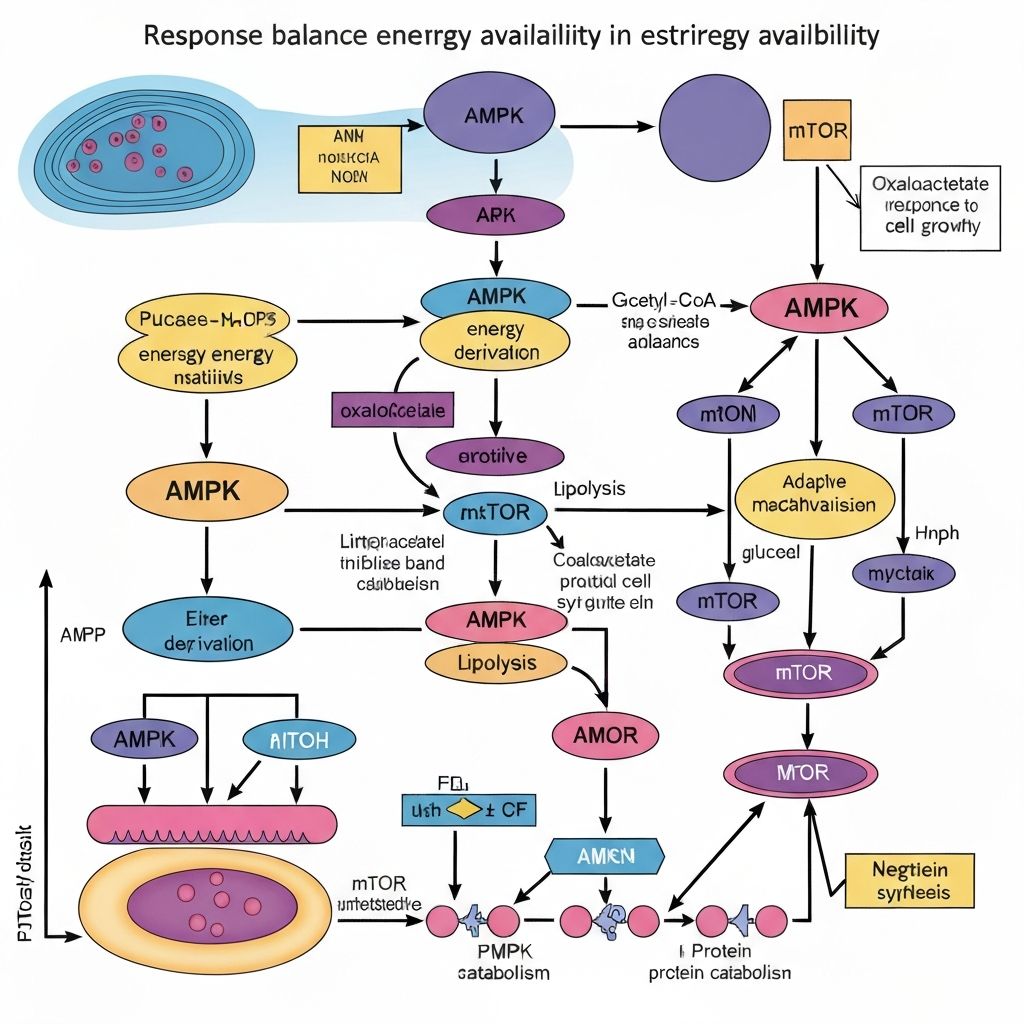
AMPK: The Cellular Energy Sensor
AMP-activated protein kinase (AMPK) functions as a cellular "fuel gauge" that detects energy depletion and activates compensatory mechanisms. When ATP is being hydrolysed faster than it is being regenerated—a condition of energy deficit—AMP and ADP accumulate whilst ATP decreases. The AMP/ATP ratio rises, activating AMPK through two primary pathways.
First, AMP directly binds to the regulatory gamma subunit of AMPK, causing allosteric activation. Second, upstream kinases including LKB1 and CaMKK phosphorylate and activate AMPK in response to elevated AMP/ADP ratios. Once activated, AMPK initiates a cascade of phosphorylation events that suppress anabolic pathways and activate catabolic ones.
AMPK Suppression of mTOR
One of the primary targets of activated AMPK is the mTOR pathway. AMPK phosphorylates the tuberous sclerosis complex protein TSC2, enhancing its ability to suppress mTOR's upstream activator Rheb. The result is potent suppression of mTORC1 activity, which translates to reduced protein synthesis rate and reduced anabolic signalling.
This suppression makes biological sense: when cellular energy is depleted, the cell prioritises energy-expensive anabolic processes like protein synthesis in favour of energy-conservation pathways like autophagy and catabolism. The AMPK-mediated suppression of mTOR represents an adaptive mechanism that preserves energy for essential cellular functions during times of scarcity.
Energy Deficit and Elevated AMPK Activity
During sustained energy deficit, AMPK activity remains chronically elevated due to persistently reduced ATP availability. This elevation suppresses mTOR-dependent anabolic processes throughout the deficit period. In the absence of other signals, this elevated AMPK activity would result in suppressed muscle protein synthesis and progressive lean mass loss.
Importantly, this AMPK elevation occurs independent of training. A sedentary individual in energy deficit experiences elevated AMPK and suppressed mTOR just as a trained individual does. The key difference is that resistance training generates signals that override this AMPK-mediated suppression, at least acutely.
Training-Induced Override of AMPK Suppression
Resistance training generates mechanical and metabolic signals that directly activate mTOR through mechanisms independent of AMPK status. Calcium influx, RhoA activation, and direct mechanosensitive pathways all converge to activate mTOR despite concurrent AMPK elevation. This represents a form of signal "dominance," where training signals override the energy-deficit signal.
The override is not complete or permanent. Training-induced mTOR activation is acute and transient, typically lasting 2–6 hours post-exercise with elevated protein synthesis persisting for up to 48 hours. Between training sessions, AMPK-mediated suppression resumes, maintaining the chronic energy-conservation state. However, the repeated cycles of post-exercise mTOR elevation can shift net protein balance toward retention if sufficient amino acids are available during these windows.
Mechanotransduction Dominance
Research demonstrates that acute mechanical signals from resistance training generate sufficiently powerful mTOR activation to transiently override AMPK suppression. This principle explains several empirical observations: (1) high-tension resistance training remains effective during energy deficit, (2) training-induced protein synthesis elevation occurs despite deficit-related AMPK elevation, and (3) muscle preservation during deficit improves substantially with training despite chronic metabolic suppression.
The magnitude of override depends on training intensity. Higher-load training generates more potent mechanical signals and greater mTOR activation than lower-load training. This mechanical dominance principle explains why high-tension training is more protective against lean mass loss during deficit than high-repetition, low-load training.
AMPK-Activated Autophagy and Muscle Breakdown
Beyond mTOR suppression, AMPK activation triggers a second pathway affecting lean mass: autophagy, an intracellular degradation process that breaks down cellular components. During energy deficit, AMPK-activated autophagy contributes to the mobilisation of amino acids from muscle proteins, supporting systemic amino acid availability for gluconeogenesis and other catabolic processes.
Resistance training appears to reduce AMPK-mediated autophagy signalling, at least acutely, through mechanisms overlapping with mTOR activation. Additionally, mechanical stress may directly inhibit autophagy through mechanotransductive pathways. The net effect is reduced autophagy-mediated muscle breakdown during and shortly after training, complementing the training-induced elevation of muscle protein synthesis.
Amino Acid Sensing and mTOR Restoration
The AMPK-mTOR balance is further modulated by amino acid availability. Adequate protein intake, particularly of branched-chain amino acids like leucine, activates mTOR through leucine-sensing pathways involving sestrin and GATOR complexes. This amino acid-dependent activation can partially restore mTOR activity even when AMPK is elevated due to energy deficit.
This mechanism explains the importance of adequate protein intake during energy deficit: protein consumption activates mTOR through amino acid sensing, complementing the mechanical activation from resistance training. The combination of training-derived mechanical signals + amino acid-derived nutrient signals creates an especially potent mTOR activation stimulus that can substantially reduce net protein loss during deficit.
Practical Integration
The AMPK-mTOR crosstalk framework illustrates that energy deficit creates a chronically suppressive metabolic environment for protein synthesis, yet resistance training and adequate amino acid availability can transiently activate protein synthesis within this constrained state. The cumulative effect of repeated training sessions and consistent protein intake can maintain or modestly improve lean mass retention despite overall energy deficit.
However, the protective capacity has limits. Severe or prolonged deficits that persistently suppress AMPK insufficiently can eventually overcome training-driven override, leading to progressive lean mass loss. Understanding this balance helps explain why moderate deficits with adequate training respond favourably to lean mass retention, whilst severe deficits show progressive losses despite best efforts.
Important Limitations and Context
This article presents educational information on cellular signalling mechanisms. Content is informational only and does not constitute personal nutritional or exercise recommendations. Individual metabolic responses vary. For decisions regarding diet or training, consult qualified professionals.